
Aligners and braces: explain the tooth-movement job
The AAO's June 2026 underbite article describes aligners as an option for selected mild cases that are primarily dental. In a proposal such as Alex's, the useful explanation identifies which tooth positions the plan addresses. Fixed braces are another orthodontic appliance category discussed in underbite care.
The category name does not establish the entire plan. A clinician still connects the assessed contribution, intended change and personal directions. A preference for removable aligners can be part of that conversation without becoming evidence that an individual jaw contribution can be addressed by tooth movement alone.
Forward change and widening are different purposes
The British Orthodontic Society's 2019 protraction-headgear leaflet describes a facemask or reverse-pull approach as bringing the upper teeth/jaw forward. It describes forehead and chin supports connected to an upper appliance. That is a front-to-back purpose in a growing-patient discussion.
Widening is a separate purpose across the upper arch. The leaflet discusses the possibility of a widening component alongside protraction; that does not make the two changes interchangeable or prescribe a sequence for everyone. Maya's fictional proposal names each goal separately for exactly this reason.
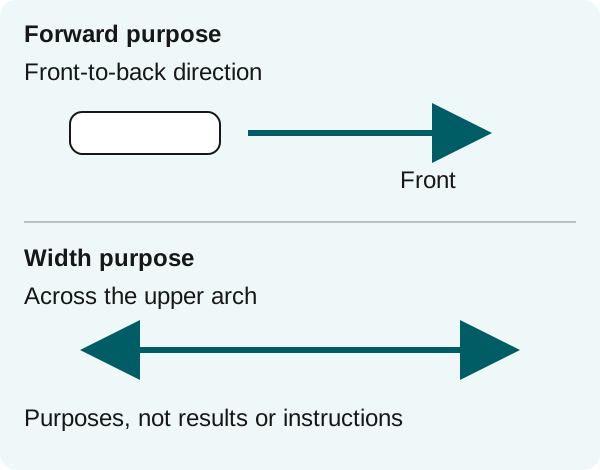
The image's complete meaning is also in the text: a forward purpose concerns front-to-back change; a width purpose concerns change across the arch. Neither arrow tells a reader which method they need.
Immediate study findings do not establish a lasting result
Cochrane's 2024 review, with evidence current through January 2023, found evidence of immediate bite or jaw improvements for several interventions in children, with confidence differing by comparison. That supports discussing a possible treatment purpose. It does not establish an individual outcome.
Longer-term evidence is much more limited: only one trial in the review supplied longer follow-up. Whether benefits last and whether early treatment prevents adult surgery remain uncertain. Read those limits alongside the AAO article's positive general discussion, rather than treating optimistic wording as a promise.
The review concerns children and teens; it does not predict Alex's adult result. Its studies also do not provide a personal force, activation, wear or review schedule. The dated 2019 BOS leaflet supplies general mechanism context, while the treating orthodontist supplies an individual's directions.
When a jaw contribution needs another kind of discussion
An adult's assessed jaw contribution may lead to a combined orthodontic and surgical-care discussion where appropriate. That is a discussion of different professional responsibilities, not an inevitable destination for every underbite. An aligner proposal, a growth approach and a combined-care proposal should each have their own stated purpose.
- Understand orthodontic and surgical-care responsibilities
- Explore the separate question of adult transverse expansion
- Separate a child's widening goal from tooth alignment
These educational categories do not advertise a facemask inventory, headgear protocol or surgery service at SMILE-FX®. The individual orthodontist explains the services and options actually proposed for you.
Sources for this lesson
Sources: AAO: Underbite causes and options (2026) · Cochrane: Underbite treatment in children (2024) · BOS: Protraction headgear leaflet (2019)